Key Takeaways
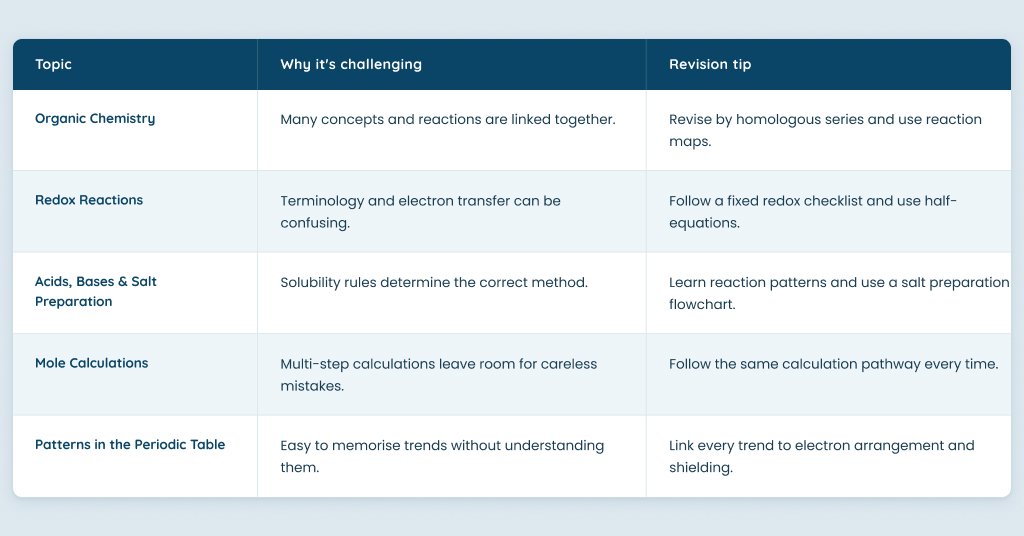
- According to students, the most challenging O-Level Chemistry topics include Organic Chemistry, Redox Reactions, Acids and Bases, The Mole Concept and Stoichiometry, and Patterns in the Periodic Table.
- These topics become easier when you focus on patterns, processes and the reasons behind each step instead of memorising isolated facts.
- Reaction maps, redox checklists, salt preparation flowcharts and fixed calculation pathways can make revision more structured.
- Practising with unfamiliar examples helps you apply what you know when examination questions are presented differently.
- Reviewing the exact cause of each mistake can make your revision more focused and prevent repeated errors.
Introduction
O-Level Chemistry can feel tricky when a question asks you to do more than repeat a definition or equation. You may need to interpret unfamiliar information, connect concepts from different chapters, or explain your reasoning using precise scientific terms.
From our experience teaching students at The Chemistry Practice, the hardest topics in O-Level Chemistry are not always those with the most content. Rather, they are usually the ones where several small skills must come together. A student may understand each idea separately but start feeling unsure when an examination question combines them.
The good news is that once you identify the exact step causing difficulty, even the hardest chapters can become much more manageable. Below, we take a closer look at the O-Level Chemistry topics our students most commonly struggle with, why these areas can be challenging, and the practical steps you can take to improve.
O-Level Chemistry Topics That Our Students Commonly Struggle With
Topic #1: Organic Chemistry
Organic Chemistry is the study of carbon-containing compounds and the reactions they undergo. In O-Level Chemistry, this topic covers fuels and crude oil, alkanes, alkenes, alcohols, carboxylic acids, esters, and polymers. You will also study processes such as fractional distillation, cracking, combustion, addition, oxidation, esterification, and polymerisation.
Why Our Students Struggle
Organic Chemistry contains many connected details that students need to organise, including general formulae, functional groups, physical properties, reactions, reagents, and conditions. We often find that students can recall some of these facts individually but struggle to bring them together in a multi-part question.
The difficulty becomes more obvious when a question uses an unfamiliar compound or tests several skills at once. For example, you may know how ethanol is oxidised but feel unsure when propanol is shown as a displayed formula. You may also need to identify the homologous series, name the compound, state the reaction conditions, and predict the product, making it easy to overlook an important detail.
How to Make this O-Level Chemistry Topic Easier
Rather than memorising each equation individually, try organising the topic using the following approaches:
- Revise by homologous series and reaction pattern: Create a comparison table covering the general formula, functional group, common reactions, reagents and essential conditions for each homologous series. This helps you see both the similarities and differences between them.
- Use reaction maps to connect the compounds: For example: ‘alkane → alkene → alcohol → carboxylic acid → ester’. Add the reagent and condition above each arrow. We often use this approach with our students to help them understand how one type of compound can be converted into another.
- Practise applying reactions to different compounds: After learning how ethanol is oxidised, try the same reaction with propanol or butanol. This trains you to recognise the underlying pattern instead of depending on one familiar example.
Topic #2: Redox Reactions
Redox reactions involve oxidation and reduction taking place at the same time. In O-Level Chemistry, you will encounter redox concepts in topics such as metal displacement, extraction of metals, corrosion, and electrolysis. You will need to recognise whether substances have gained or lost oxygen, hydrogen, or electrons.
Why Our Students Struggle
Students often struggle with this O-Level Chemistry topic because the terminology can feel counterintuitive. The substance that is oxidised loses electrons, while the substance that is reduced gains electrons. At the same time, the oxidising agent is itself reduced, while the reducing agent is oxidised. We often see students understand the electron transfer but become confused by how the agents are named.
Mathematical errors are another common mistake, especially when students are trying to balance ionic half-equations. They may overlook an ion’s charge, assign an incorrect oxidation number, or add the wrong number of electrons to balance the overall charge.
How to Make this O-Level Chemistry Topic Easier
In our experience, questions about redox reactions are easier to tackle when students follow the same process for every question.
- Use a fixed redox checklist: First identify what has been gained or lost, then decide which substance is oxidised and which is reduced. Only after that should you name the oxidising and reducing agents.
- Separate the substance from the agent: A useful way to remember this is that the oxidising agent causes another substance to be oxidised, so it is itself reduced. The reducing agent causes reduction, so it is itself oxidised. Writing these as two separate steps can prevent the terms from becoming mixed up.
- Use half-equations for electron transfer questions: Half-equations make the loss and gain of electrons easier to see. For example, if a metal atom forms a positive ion, the electrons should appear on the product side because they have been lost.
Students should practise different reactions in different forms. Work through redox questions involving oxygen transfer, metal displacement, and electrolysis. This helps you recognise that the wording may change, but the underlying idea of oxidation and reduction remains the same.
Topic #3: Acids, Bases and Salt Preparation

Acids and bases cover reaction patterns, indicators, neutralisation, titration, and salt preparation. In O-Level Chemistry, you will need to know how acids react with metals, metal oxides, metal hydroxides, alkalis, and carbonates, as well as how different salts are prepared.
Why Our Students Struggle
Acids, bases and salt preparation is relatively straightforward compared with some other O-Level Chemistry topics, but it is also an important foundation for many questions across the syllabus. Students who are unsure about ions, chemical formulae or balanced equations may find it harder to predict reaction products, understand neutralisation, or write ionic equations correctly.
Solubility rules are another common difficulty. You may remember the rules individually but still feel unsure when deciding whether a salt is soluble, which reactants to use and whether titration, precipitation, or the excess insoluble solid method is suitable.
How to Make this O-Level Chemistry Topic Easier
Instead of memorising individual reactions and practical methods, organise the topic into patterns that you can apply during an exam.
- Group reactions by the reactant, not the acid: Create a table showing what happens when an acid reacts with a metal, metal oxide, alkali or carbonate. This helps you recognise the products quickly, even when the acid changes.
- Draw a simple flowchart for salt preparation: Start by asking, “Is the salt soluble?” Then follow the decision pathway to decide whether titration, the excess insoluble solid method or precipitation should be used. After enough practice, this process becomes automatic.
- Explain the purpose of every practical step as you revise: Rather than memorising a sequence of steps, ask yourself why each one is needed. For example, filtration removes excess insoluble solid, evaporation concentrates the solution, crystallisation forms the salt crystals and drying removes surface water. Understanding the purpose behind each step makes practical questions much easier to answer.
Topic #4: Mole Calculations
Mole calculations involve using chemical formulae and balanced equations to work out quantities such as mass, amount of substance, concentration, gas volume, empirical formula, and percentage yield. Unlike O-Level Chemistry topics that rely mainly on recall, this area requires you to combine Chemistry knowledge with a clear mathematical process.
Why Our Students Struggle
Many of our students tend to struggle with mole concept questions that involve several linked steps. You may need to convert a mass into moles, use the mole ratio from a balanced equation, and then convert the result into a different quantity. Even when students know the individual formulas, they may still be unsure where to begin or which calculation should come next.
Small errors can also affect the entire answer. An incorrect relative formula mass, an unbalanced equation, or a reversed mole ratio may lead to the wrong final result. Unit conversions are another common source of lost marks, especially when students forget to convert between cm³ and dm³ or leave out the correct unit.
How to Make This O-Level Chemistry Topic Easier
The key is to use the same sequence for every mole question rather than deciding on a formula as you go.
- Follow a fixed calculation pathway: First write and balance the equation. Next, convert the quantity given into moles, apply the mole ratio and then convert the result into the quantity required.
- Write the mole ratio before inserting numbers: Take the ratio directly from the balanced equation and set it out clearly. This makes it easier to see whether you are comparing the correct substances and reduces the chance of reversing the ratio.
- Practise in stages and check your units: Start with one question type, such as mass-to-mole calculations, before moving on to concentration, gas volume, empirical formula and percentage yield. At the end of each calculation, check that the unit matches what the question asks for.
Topic #5: Patterns in the Periodic Table
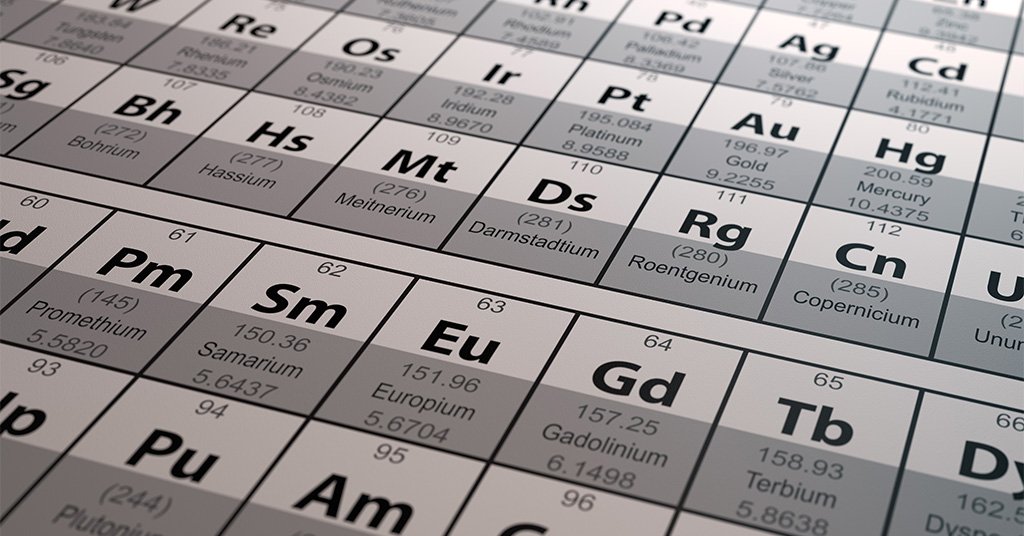
Patterns in the Periodic Table link an element’s position to its electron arrangement, chemical properties, and reactivity. In O-Level Chemistry, you will study trends in Group I and Group VII, as well as how group and period numbers can be used to predict ion charge and chemical behaviour.
Why Our Students Struggle
Our students often remember the trends but not the reasoning behind them. For example, they may know that Group I metals become more reactive down the group and Group VII elements become less reactive, yet struggle to explain how electron shells, shielding and nuclear attraction cause these opposite patterns.
Questions can become more challenging when they use an unfamiliar element instead of sodium, chlorine or another example seen in class. To answer well, you need to use the element’s position in the Periodic Table to predict its properties and then explain the trend using a complete chain of reasoning.
How to Make this O-Level Chemistry Topic Easier
Mastering this O-Level Chemistry topic becomes easier when you connect each trend to electron arrangement rather than memorising it as an isolated fact. Start by linking the group number to the number of outer-shell electrons, then ask whether the element needs to gain or lose electrons to form an ion.
It also helps to revise Group I and Group VII separately before comparing them. Create a short table for each group, then practise applying the trend to unfamiliar elements and writing the full explanation from atomic size and shielding to nuclear attraction and reactivity.
How to Revise Effectively for O-Level Chemistry: Our Tips and Tricks
Identifying the O-Level Chemistry topics that you struggle with is only the first step. The way you revise determines whether you can apply the ideas when a question looks different from the examples in your notes.
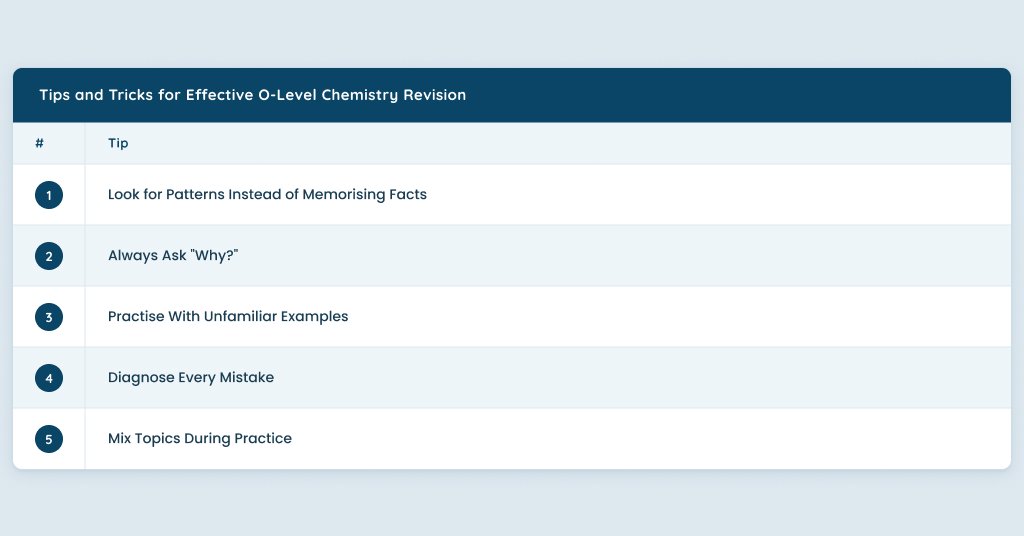
Look for Patterns Instead of Memorising Facts
Many Chemistry questions test the same underlying ideas in different ways. Instead of memorising individual reactions or equations, organise your notes into patterns.
For example, group all acid reactions together, create reaction maps for Organic Chemistry or compare Group I and Group VII trends side by side. We often find that students become much more confident once they start recognising these patterns instead of treating every fact as something new.
Always Ask “Why?”
If you can explain why a reaction happens, you’re much more likely to answer unfamiliar questions correctly.
Instead of memorising that Group I metals become more reactive down the group, explain the trend using atomic size, shielding and nuclear attraction. Instead of remembering that filtration comes before crystallisation, ask yourself what filtration is removing. This habit helps you understand the concept instead of relying on memory alone.
Practise with Unfamiliar Examples
O-Level Chemistry exam questions often replace familiar compounds with ones you have not seen before.
For example, if you have learnt how ethanol is oxidised, try predicting the products for propanol or butanol. If you have practised sodium reacting with water, think about how potassium would behave. We often encourage our students to change one detail in a familiar question because it trains them to apply concepts instead of recognising examples.
Learn from Every Mistake
Completing more papers is only useful if you review them carefully afterwards. Instead of writing “got this wrong”, identify the exact reason. Did you miss the reaction condition? Reverse the mole ratio? Forget a state symbol? Misread the command word? The more specific you are, the less likely you are to repeat the same mistake.
Mix Topics Together
O-Level Chemistry questions rarely test one topic or chapter in isolation. A single structured question might combine mole calculations, redox and electrolysis, or Organic Chemistry with practical techniques.
As your O-Level Chemistry exams get closer, stop revising one topic at a time and begin mixing chapters in your practice. This better reflects the way questions appear in the examination and helps you learn when to apply each concept.
Mastering O-Level Chemistry Revision at The Chemistry Practice

At The Chemistry Practice, we often meet students who tell us they have revised an O-Level Chemistry topic many times but still feel unsure. In many cases, the problem is not a lack of effort. They may be memorising notes without seeing the patterns between reactions, calculations and question types.
This is where our O-Level Chemistry tuition programme can provide additional structured guidance. Our classes use the T.C.P. methodology, which combines Techniques, Content Mastery, and Practice. We help students understand the concept first, then show them how to recognise and apply it in examination questions.
Our lessons focus on:
- Building clearer foundations: We break reactions, calculations, and practical concepts into manageable stages so students understand why each step is needed.
- Developing answering techniques: Students learn to identify what a question is testing, organise their working, and use precise Chemistry terms.
- Applying ideas regularly: Weekly quizzes and exam-style questions help students check whether they can apply a concept without relying on notes.
- Correcting misunderstandings early: Our Chemistry tutors provide detailed, personalised feedback during lessons and are available for questions through WhatsApp. This allows students to clarify their doubts before they repeat the same errors.
With the right structure and support, we’re here to help students stop treating Chemistry as a collection of facts to memorise and start seeing how the concepts fit together. As these connections become clearer, unfamiliar questions feel less intimidating, and revision becomes more purposeful and efficient.
Sign up for a free trial lesson and experience our approach for yourself today.